Blog
.png)
Nick Bonitatibus
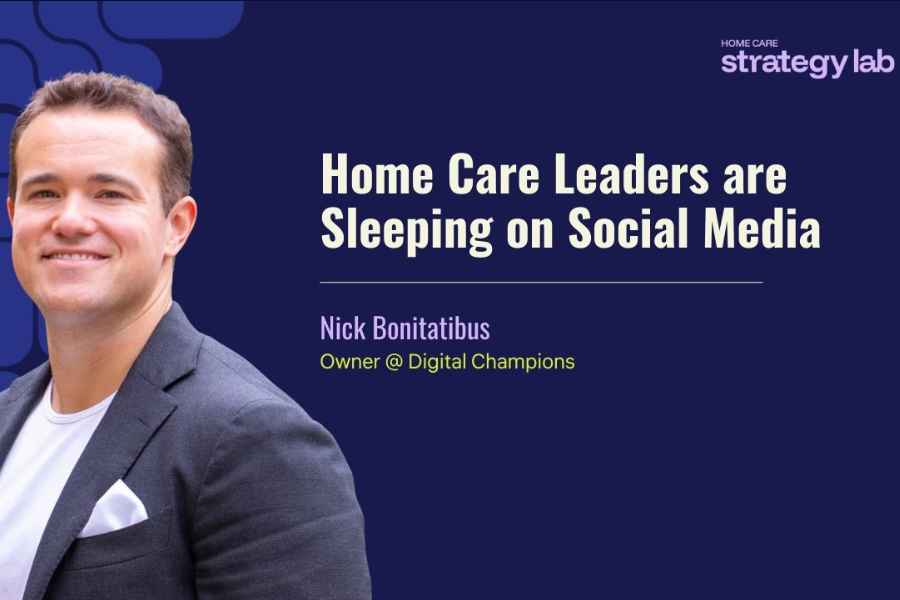
I recently joined Miriam Allred on the Home Care Strategy Lab podcast, and we spent our time on one topic that keeps coming up with home care leaders:
Social media is still wildly underused in this industry, especially LinkedIn.
Not because owners don’t care. It’s because home care is hard, the days are full, and “online presence” can feel like a nice-to-have.
But the reality is: your digital presence is no longer optional if you want to stay competitive, recruit consistently, and build long-term leverage as a leader.
Here’s what Miriam and I discussed, and what I’d want any home care executive to take away from the conversation.
Miriam opened by asking why I do what I do, and my answer comes down to one word: impact.
Home care is one of the few industries where the mission is real. You meet owners who are doing this for the right reasons, serving families, supporting caregivers, and trying to build something meaningful in their communities.
I’ve been in and around home care for 11 years, and I can honestly say: the quality of people in this space is rare.
That’s why I’m here.
The platforms change. The algorithms change. The tools change.
But the core purpose of social media hasn’t changed:
It’s built for relationships.
That’s it.
And the agencies that win online aren’t the ones playing “algorithm games.” They’re the ones consistently doing the same thing that already works in home care:
Miriam said something that’s half-joking, half-true, and I agree with her:
If someone searches you on LinkedIn and you’re not there… you basically don’t exist.
That doesn’t mean you need to become an influencer. But it does mean this:
If people can’t quickly understand who you are, what you do, and what you stand for, you’re losing trust before the relationship even starts.
I like to explain it this way:
Not having a personal brand is like having a business with no website.
It’s not that you can’t succeed without it.
It’s that you’re making everything harder than it needs to be.
A lot of owners reach a point where they want the brand to stand on its own, and they don’t want every piece of visibility to run through them.
That’s reasonable.
But here’s the mistake I see: leaders try to delegate social media without first setting the standard for how the brand should show up.
If you hired a recruiter and gave them no process, no expectations, no training, and no message… you’d get inconsistent results.
Your online presence works the same way.
If you want your team to execute, leadership still needs to define:
From there, it becomes a team effort, and it can scale.
Here’s my simplest take:
If you have a great culture, social media becomes easy.
Because you’re not “creating content.” You’re documenting reality.
Team moments. Training. Celebrations. Community involvement. Caregiver wins. Stories that show what your agency is actually like.
And please, this is important:
If your feed is full of stock photos, it doesn’t matter what your caption says. People don’t believe it.
Show the real thing.
I gave Miriam three common mistakes that are holding agencies back:
1) Stop using social media like a billboard
Constantly promoting your services in organic posts comes off salesy and doesn’t build trust.
If you want to advertise, run ads. Organic should feel human.
2) Stop posting links all the time
Social platforms make money by keeping people on-platform. Links send people away, which often reduces reach.
3) Stop relying on hashtags as a strategy
Hashtags aren’t the lever people think they are. Content quality and consistency matter far more.
Home care leaders usually have three audiences:
The mistake is trying to talk to each group separately in a way that feels fragmented.
The better approach is to post content that acts as proof across all three audiences.
Example: a caregiver testimonial.
The right content does more than one job.
If you’re ever stuck on what to post, you’re not lacking ideas.
You’re lacking a storytelling habit.
Some of the best content comes from simple prompts:
One small but important note:
Don’t just screenshot a Google review and post it.
Add context. Tell people what happened. Share why it mattered. Let your audience feel what your team felt.
That’s what makes it real.
If you’re a home care leader and you only have a small amount of time each week, here’s what I’d prioritize:
1) Build your network intentionally
Connect with people you already know: team members, referral partners, community contacts, peers.
LinkedIn becomes powerful when it reflects your real-world relationships.
2) Post leadership content that highlights others
Recognize a team member. Thank a referral partner. Share what you’re learning.
Public recognition builds culture internally and trust externally.
I use AI constantly.
But I’m careful about one thing:
If your content doesn’t sound like you, don’t post it.
AI can help you brainstorm, outline, draft, and organize. But if your audience can “sniff” that it’s automated, you lose trust.
And in home care, trust is everything.
Miriam and I agreed on this:
The strongest agencies don’t treat digital and referral marketing as separate worlds.
They work together.
Your community relationships create trust.
Your online presence scales that trust.
And the agencies that do both well create a compounding advantage over time.
You don’t need to post every day.
You don’t need to become a content creator.
You don’t need to chase trends.
You just need to show up consistently and prove what’s already true about your agency.
In a world where more content is becoming automated and fake, real leadership and real culture stand out more than ever.
Get the latest insights and blog posts delivered straight to your inbox weekly.
Unlock your potential and start generating leads effortlessly with our proven program.
Schedule A Call